



Your lease says no holes in the walls. Your walls, meanwhile, are a wide expanse of beige, and beige has started to feel less like calm and more like a rental agreement you stare at every evening. You can fix that without a drill, without an argument at move-out, and without spending much. What follows are ten renter-friendly approaches to wall decor, sorted by how they attach — plus the small habits that keep them from leaving marks behind.
Know Your Walls Before You Stick Anything To Them
Adhesive products live or die by the surface they meet. Smooth, sealed, painted drywall is the ideal host. Textured walls, bare brick, peeling paint and most wallpapers are not: the adhesive grabs the top layer instead of the wall itself and takes that layer with it on removal.
So test first. Stick one strip somewhere nobody will see — inside a closet, behind a bookshelf, behind the headboard — and leave it for a week. If it comes off cleanly with the paint intact, you have your answer. Two other rules worth following: wipe the wall with isopropyl alcohol and let it dry completely before sticking, and wait about a week after any fresh paint. And keep glass frames, mirrors and anything heavy off the wall directly above a bed, crib or sofa, where a fall could actually hurt someone.
Removable Hooks and Strips: What Actually Matters
Not all adhesive hardware is equal, and the packaging rarely explains the difference. A few things to look for:
- Buy a margin. If a frame weighs two pounds, choose strips rated for four or more. Ratings assume a clean, smooth, correctly prepared surface.
- Two small strips beat one big one on a wide, flat frame — one near each top corner keeps the piece level and spreads the load.
- Clip-style strips hold an unframed canvas, a calendar or a rotating set of prints with no frame at all.
- Wire-backed hooks suit wreaths and small seasonal pieces you want to swap every few months.
- Skip adhesive entirely on wallpaper, freshly painted walls and anything that already feels loose or bubbled.
Installation matters as much as the product. Press each strip firmly against the wall for about thirty seconds, then wait before hanging anything — an hour at minimum for light items, longer in steamy bathrooms and kitchens. To remove, hold the wall steady with one hand and pull the tab straight down, slowly, keeping it parallel to the wall. Yanking the tab outward is what tears paint. If a strip resists, warm it for a few seconds with a hair dryer on low and try again.
Lean It, Don't Hang It
The fastest fix for an empty wall is a large canvas resting on the floor, tilted back against the baseboard. Layer a smaller framed print in front of it and you have depth without a single fastener. The same trick works on top of a dresser, a bookshelf, a sideboard or a mantel — a row of small frames leaning at a slight angle reads as intentional, not unfinished.
Picture ledges give you the look without the drilling; narrow ones mounted with heavy-duty adhesive strips hold several small frames, and you can rearrange them whenever you get bored. If you have pets, kids or a wobbly floor, a dab of museum putty under each corner stops the sliding. Keep leaning pieces away from radiators, floor vents and walking paths, and secure anything taller than about three feet so it cannot tip.
Tension Rods Are Not Just for Curtains
A tension rod needs two parallel surfaces and nothing else. In a window recess, it holds a curtain panel with no brackets at all — measure the inside width of the opening and choose a rod whose adjustable range comfortably covers it. In an alcove, a deep closet doorway or between two built-ins, the same rod becomes a hanging rail for a fabric panel, a lightweight quilt used as a headboard, a macramé piece or a trailing plant.
Respect the limits. Tension rods rely on outward pressure, so they are not the tool for heavy blackout drapes or anything more than a few pounds. Check the rod after the first week and give it a twist to re-tighten. For windows without a recess, adhesive curtain rod brackets handle lightweight sheers and linen panels fine.
Five More Ideas That Cost Almost Nothing
Tape, clips and paper
Washi tape is low-tack and forgiving — use it to frame a poster, arrange a grid of postcards, or pin up a rotating photo wall. It still needs a test spot, since delicate paint can lift. Adhesive clip strips along a wall near a desk make an instant display for notes, prints and fabric swatches.
Peel-and-stick surfaces
Removable wallpaper and decals can transform a wall, but they are the riskiest item on this list. Ask your landlord before you install anything, keep the backing paper so panels can be re-rolled, and consider one accent panel behind a bed or sofa rather than a whole room. Skip them on textured walls and on paint that has not fully cured.
Freestanding pieces
A folding screen, a leaning ladder shelf or an easel adds height and color with zero contact with the wall. An over-door hanger turns a door into display space for a wreath or a lightweight seasonal piece.
The Ten, In Short
- Removable adhesive hooks and strips for lightweight art
- Picture ledges and narrow shelves held with heavy-duty strips
- Oversized art leaning against the wall, layered with smaller frames in front
- Tension rods in window recesses and alcoves for curtains and fabric panels
- Adhesive curtain rod brackets for lightweight sheers
- Washi tape and clip strips for prints, photos and postcards
- Peel-and-stick wallpaper or decals on a single accent panel
- Wall hangings and textiles suspended from a wooden dowel
- Freestanding screens, ladder shelves and easels
- Over-door hangers for wreaths and seasonal pieces
Before You Move Out
Damage-free is really a matter of degree. A pushpin hole or a small nail hole disappears with a dab of lightweight spackle and a swipe of touch-up paint; an anchor the size of your thumb does not. That is the whole argument for the methods above.
Keep a small kit on hand: spackle, a plastic putty knife, a sanding sponge, and a paint sample matched at the hardware store before you forget the color. Walk the room against your lease's move-out checklist a week early so nothing is a surprise, and if your lease requires approval for wallpaper or hardware, get that approval in writing — a text from your landlord counts. Then leave the walls exactly as you found them and take the good ideas with you.
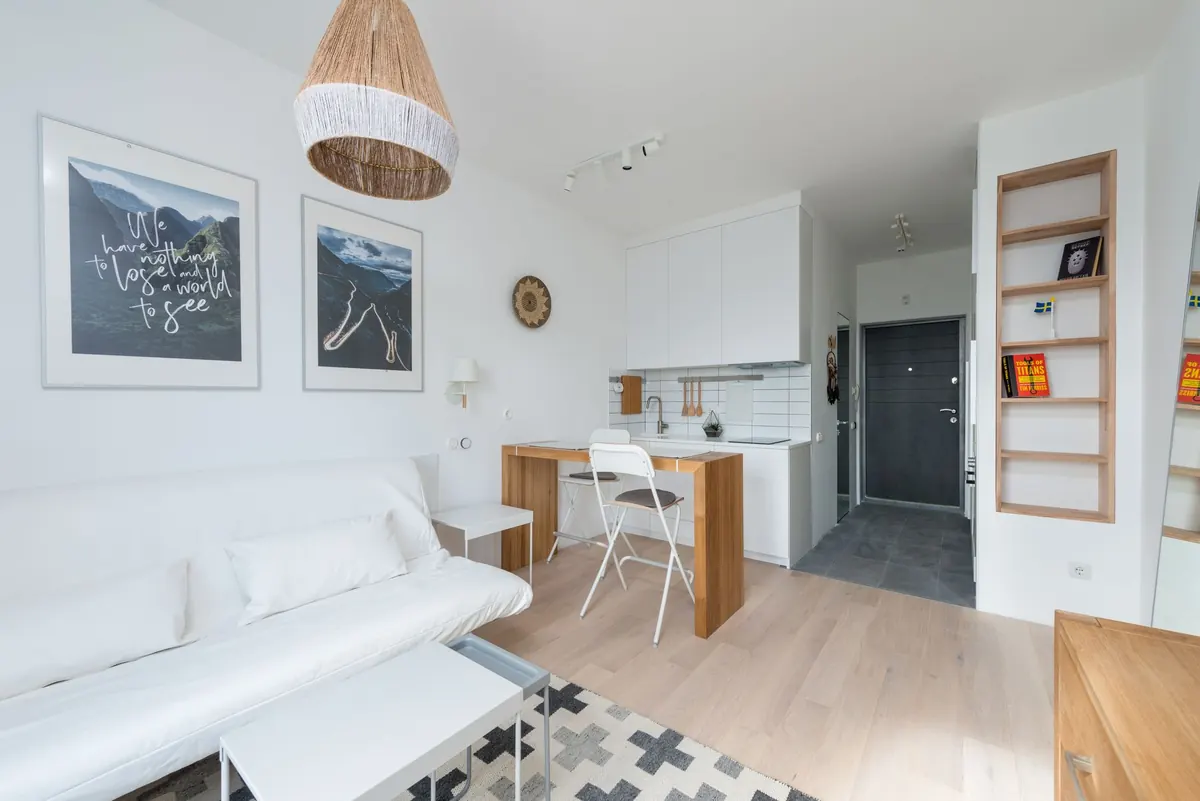
Photo: Max Vakhtbovych / Pexels